The short answer
For most babies, no. The American Academy of Pediatrics (AAP), the NIH’s Safe to Sleep campaign and the FDA all say no monitor has been shown to prevent SIDS, and the AAP advises against using one for that. If one would give you peace of mind, the AAP says that’s fine, as long as it never takes the place of safe sleep. In the US, check that a monitor which reads oxygen or heart rate is FDA-authorized: many sold online aren’t.
What these monitors are
They watch your baby’s body rather than the room. The FDA groups them by where they sit:
- Worn by your baby, on the foot or the belly. Sock monitors shine a light through the skin to read oxygen level and pulse, the way a hospital finger clip does.
- Under the mattress. A movement pad senses your baby’s movement, breathing included. If it feels nothing for a while, usually 20 seconds, it sounds an alarm, the Lullaby Trust explains.
- A camera on the wall that tracks breathing from the picture.
An ordinary baby monitor, audio or video, does none of this. It lets you hear and see the room.
Do they prevent SIDS?
No, and the three bodies that set the advice in the US say so plainly:
- The AAP: “Do not use home cardiorespiratory monitors as a strategy to reduce the risk of SIDS.” It is one of its strongest, A-level recommendations, and there are no data that other commercial devices that monitor vital signs reduce the risk either.
- The NIH’s Safe to Sleep campaign: avoid using heart, breathing, motion or other monitors to reduce the risk of SIDS. “These types of monitors are not effective at detecting or preventing SIDS.”
- The FDA: it is “not aware of any clinical or scientific evidence” that baby products available today prevent or reduce the chance of SIDS, and no device, infant monitors included, has been authorized to prevent it.
The worry the AAP raises is the opposite effect: an alarm can feel like protection, and lead families to relax the safe-sleep habits that do lower the risk.
Which ones has the FDA checked?
Very few. In September 2025 the FDA warned parents that many infant monitors sold over the counter to track vital signs have no FDA marketing authorization, so their safety and accuracy haven’t been evaluated. It says they don’t count as general wellness products, and that authorized ones carry the product code QYU.
When we checked the FDA’s device database in October 2026, two monitors were listed under that code: the Owlet Dream Sock (granted in November 2023) and the Masimo Stork (cleared in May 2024). Both are authorized to measure pulse rate and oxygen level at home. Neither is authorized to prevent SIDS: the FDA’s own summary of the Dream Sock says it “does not detect, diagnose or reduce” SIDS, and is not a substitute for adult supervision or safe sleep practices.
How accurate are they?
Authorized or not, a home monitor can be wrong in both directions. The FDA lists the risks of unauthorized ones: missing real changes in pulse, oxygen, breathing or temperature, waiting too long to get help because no alert came, burns or rashes from the sensor, and false alerts that lead to unneeded medical care.
A 2018 study in JAMA put this to the test. Researchers in Philadelphia fitted two phone-linked oxygen monitors, neither FDA-regulated at the time, to 30 babies in hospital and compared them with a hospital monitor. One caught low oxygen, but inconsistently, and sometimes read low when oxygen was normal. The other never caught low oxygen in the 14 babies who had it, and showed falsely low pulse rates in 14. The authors urged caution. Those were 2018 devices tested on unwell babies, so the results don’t describe every monitor sold today.
More numbers, more worry
Parents often buy one for peace of mind, and some find the opposite. The Lullaby Trust, a UK charity for safer baby sleep, doesn’t use oxygen and heart-rate monitors in its own programme for bereaved families, because that much detail, hard to read without medical training, “can add to anxiety rather than offer peace of mind.”
Movement pads have their own limits: they can pick up movement that isn’t your baby’s, and they won’t work reliably if your baby sleeps in your bed, because they feel your breathing too.
When a doctor might suggest one
That’s a different thing. Some babies, including some born early who have long spells of pausing in their breathing, are sent home with a monitor their doctor prescribes, to watch for breathing pauses, a slow heart rate or low oxygen (AAP). If your baby was born early or has a heart or breathing condition, ask your baby’s doctor or neonatal team whether they need one, rather than buying a consumer monitor to fill the gap.
What does lower the risk
Safe sleep, every sleep, naps included. From the AAP’s strongest recommendations:
- On their back for every sleep.
- On a firm, flat surface that isn’t tilted.
- In your room, in their own space, ideally for at least the first 6 months. Sleeping in the parents’ room on a separate surface lowers the risk of SIDS by as much as 50%, the AAP says.
- Nothing soft in the sleep space: no pillows, quilts, soft toys or loose blankets, just a fitted sheet.
- Not too warm, and nothing over their head.
The NHS adds the feet-to-foot position, your baby’s feet at the foot of the cot, and no cot bumpers or sleep pods.
If you still want one
“It’s fine to use one if you want to,” the AAP’s parent site says, “just don’t use it as a substitute” for safe sleep. A few things help:
- In the US, check for FDA authorization on anything that reads oxygen or heart rate. The FDA’s warning explains how.
- Follow the maker’s instructions, and keep the base unit out of your baby’s reach.
- Keep every cord at least three feet from the crib, bassinet or play yard, and never put a monitor inside or on the edge of the crib (CPSC).
- Know what an alarm means, and what you’ll do when one sounds, before the first night.
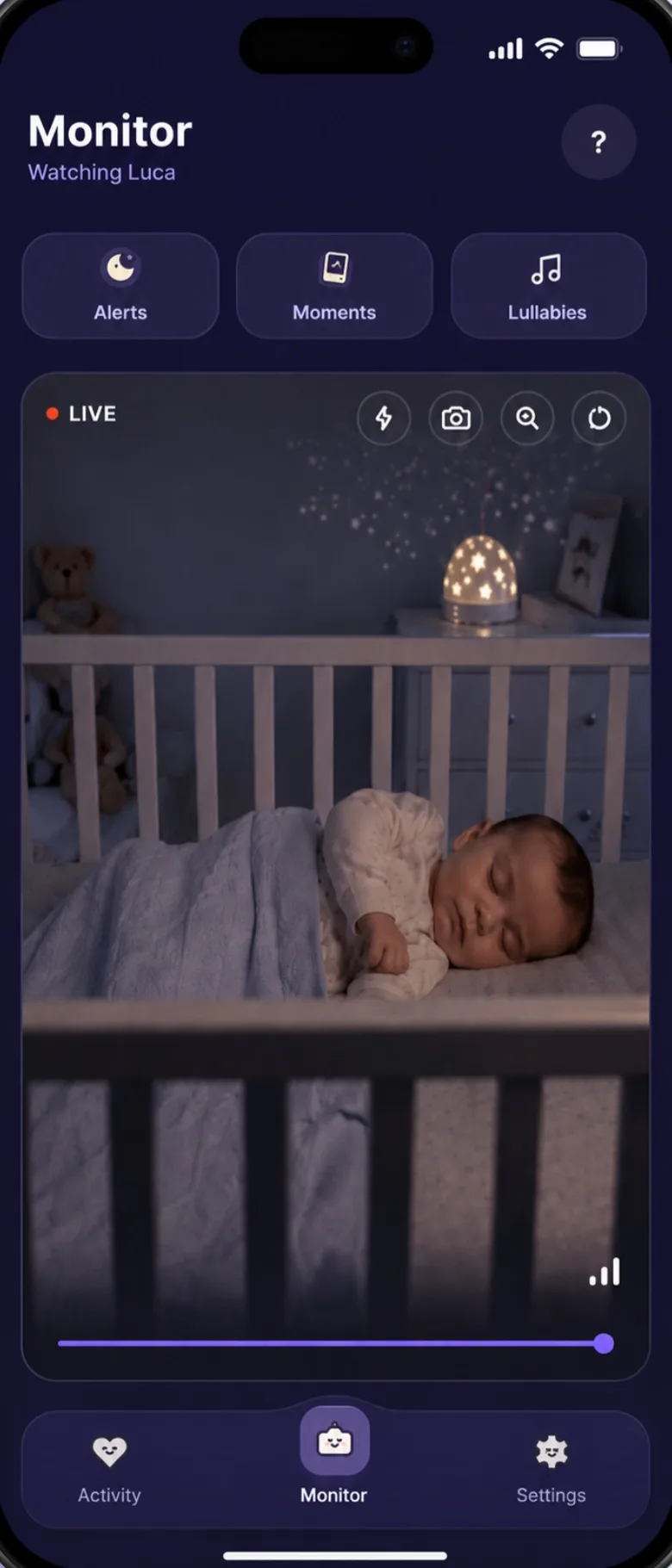
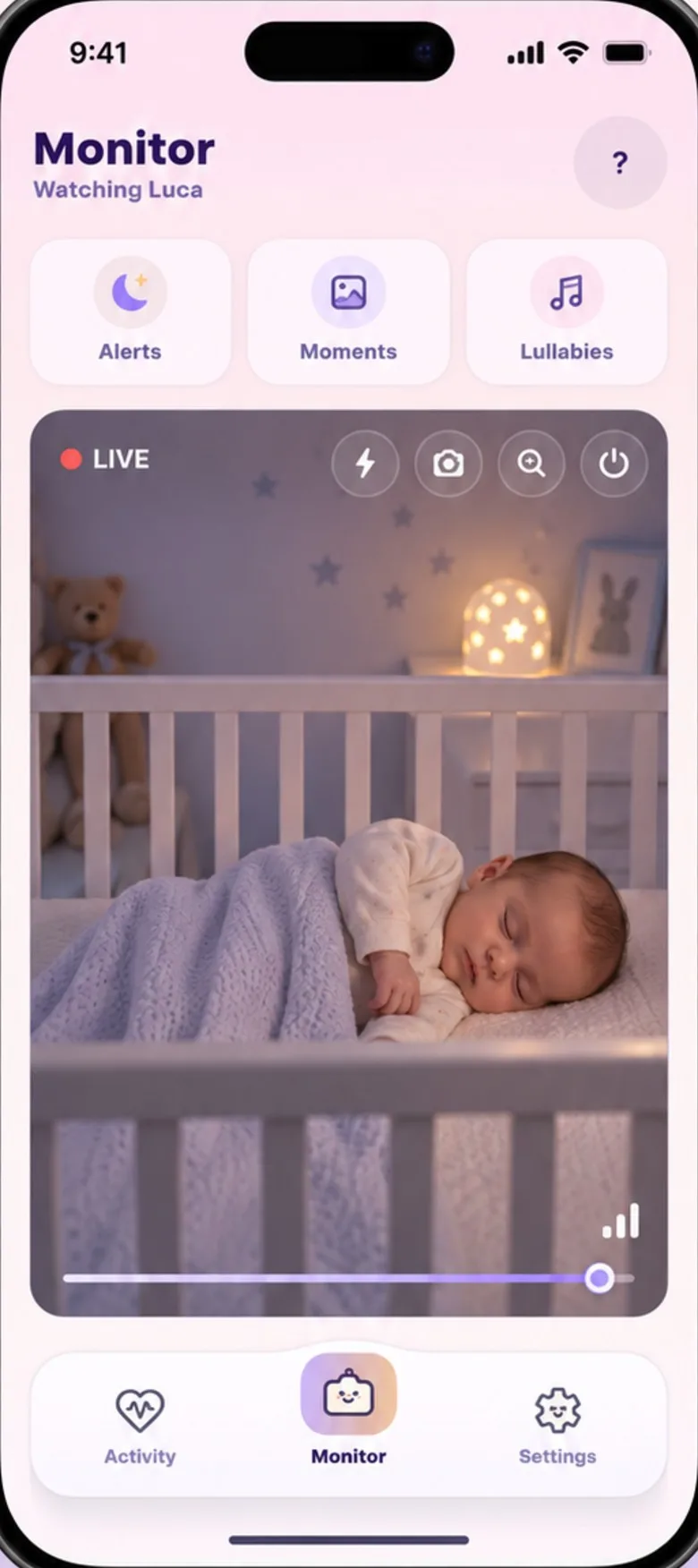
Baby’s Day In isn’t a breathing monitor. It’s a video and sound monitor on two phones: it tells you when your baby cries or leaves the picture, and it doesn’t measure breathing, heart rate or oxygen. It isn’t a medical device either.
Breathing monitors, quick answers.
Do breathing monitors prevent SIDS?
No. The AAP, the NIH’s Safe to Sleep campaign and the FDA all say there’s no evidence that any monitor prevents SIDS, and no device has been authorized to prevent it. What lowers the risk is safe sleep: on the back, on a firm flat surface, in your room in their own space, with nothing soft around them.
Are sock monitors FDA approved?
None is authorized to prevent SIDS. Two infant oxygen and pulse monitors, the Owlet Dream Sock and the Masimo Stork, were authorized by the FDA in 2023 and 2024 to measure those readings at home. The FDA says many other monitors sold online have no authorization at all.
Can a baby monitor detect breathing?
Some claim to, with a sensor under the mattress or a camera that watches for breathing. The FDA’s 2025 warning covers those too: many haven’t been evaluated, and none is authorized to prevent SIDS. A standard audio or video monitor doesn’t check breathing at all.
Do premature babies need a breathing monitor?
Some are sent home with one their doctor prescribes, to watch for breathing pauses or a slow heart rate. That decision belongs to your baby’s doctor or neonatal team. A consumer monitor isn’t a substitute for one.
Sources
- Moon RY, Carlin RF, Hand I, et al. Sleep-Related Infant Deaths: Updated 2022 Recommendations for Reducing Infant Deaths in the Sleep Environment. Pediatrics 2022;150(1):e2022057990
- American Academy of Pediatrics, HealthyChildren.org: How to Keep Your Sleeping Baby Safe: AAP Policy Explained
- NICHD Safe to Sleep campaign: Ways to Reduce Baby’s Risk
- US Food and Drug Administration: Do Not Use Unauthorized Infant Devices for Monitoring Vital Signs (Safety Communication, 16 September 2025)
- US Food and Drug Administration: Baby Products with SIDS Prevention Claims
- US Food and Drug Administration: De Novo decision summary DEN220091 (Owlet Dream Sock)
- US Food and Drug Administration: 510(k) K234021 (Masimo Stork)
- Bonafide CP, Localio AR, Ferro DF, et al. Accuracy of Pulse Oximetry-Based Home Baby Monitors. JAMA 2018;320(7):717–719
- The Lullaby Trust: Baby monitors
- NHS: Sudden infant death syndrome (SIDS)
- US Consumer Product Safety Commission: Safety Alert 5066, baby monitor cords (July 2012)