The short answer
Yes, set up with care. Health agencies have found no evidence that a phone’s radio waves harm health, and a phone a metre or more from the cot gives off far less again. The risks worth your attention are the everyday ones: a cable within reach of the cot, and a battery charging for hours. Keep the phone and its cable at least a metre, about three feet, from any part of the cot, charge it on a hard surface with its own charger, and check it now and then for heat or swelling.
Radio waves: what the evidence says
Every phone sends and receives radio waves, and a nursery phone does it all night. Here is where the research stands:
- The FDA says the weight of scientific evidence has not linked cell phone radio frequency radiation with any health problems, and that the evidence doesn’t show a danger to users, children and teenagers included.
- The World Health Organization: “no adverse health effect has been causally linked with exposure to wireless technologies.”
- A 2024 review commissioned by the WHO pooled 63 studies from 22 countries and found moderate-certainty evidence that using a mobile phone likely doesn’t raise the risk of brain tumours, in adults or in children.
- In 2011 the WHO’s cancer agency (IARC) classed radio waves as “possibly carcinogenic” (Group 2B), based on limited evidence of a link between wireless phone use and glioma, a type of brain tumour. That label means, in its words, “there could be some risk”, and that the link should be watched.
Almost all of that research is about phones held against the head for calls. A phone on a shelf across the room is a much smaller exposure, as the next section shows.
Distance does most of the work
Switzerland’s Federal Office of Public Health has a fact sheet on baby monitors that covers phones used as one. Radiation levels “decrease very rapidly with increasing distance,” it says; a phone used as a baby monitor a metre from the child is below the limit values, and based on current knowledge baby monitor radiation “is not expected to be harmful to health.” It also says the long-term effects of this kind of low-level radiation are unknown, and that keeping the monitor at a distance is how to keep exposure low.
Its advice:
- Put the baby unit at least one metre from the cot.
- Keep the power adapter at least 50 cm from the cot.
The UK Health Security Agency makes the same point about phones in general: moving a phone away from the body gives very much lower exposure than holding it to the head. In the US, every phone sold has to stay under the FCC’s exposure limit of 1.6 watts per kilogram, and most of the time a phone runs well below the power it’s tested at.
Charging all night
This is the part to take seriously. A nursery phone streams all night, so it needs to stay on its charger, and fire services advise against exactly that: the London Fire Brigade says it’s best not to leave a phone plugged in overnight, and the US National Fire Protection Association (NFPA) says not to keep charging a device once it’s full. Lithium-ion batteries rarely fail, but a small number are faulty and can overheat or catch fire, the NFPA says.
If you use a phone as a monitor, you’re choosing to charge it overnight, so stack the odds:
- Use the charger that came with the phone, or a genuine replacement from a seller you trust (London Fire Brigade, NFPA).
- Charge it on a hard, flat surface where heat can escape: never on a bed, a sofa, bedding or under a pillow, and never covered (NFPA, London Fire Brigade).
- Keep it at room temperature, out of direct sun and away from radiators, and away from anything that can catch fire (NFPA).
- Use the phone’s battery protection if it has one: many phones can stop charging at around 80% or hold off until the battery is needed.
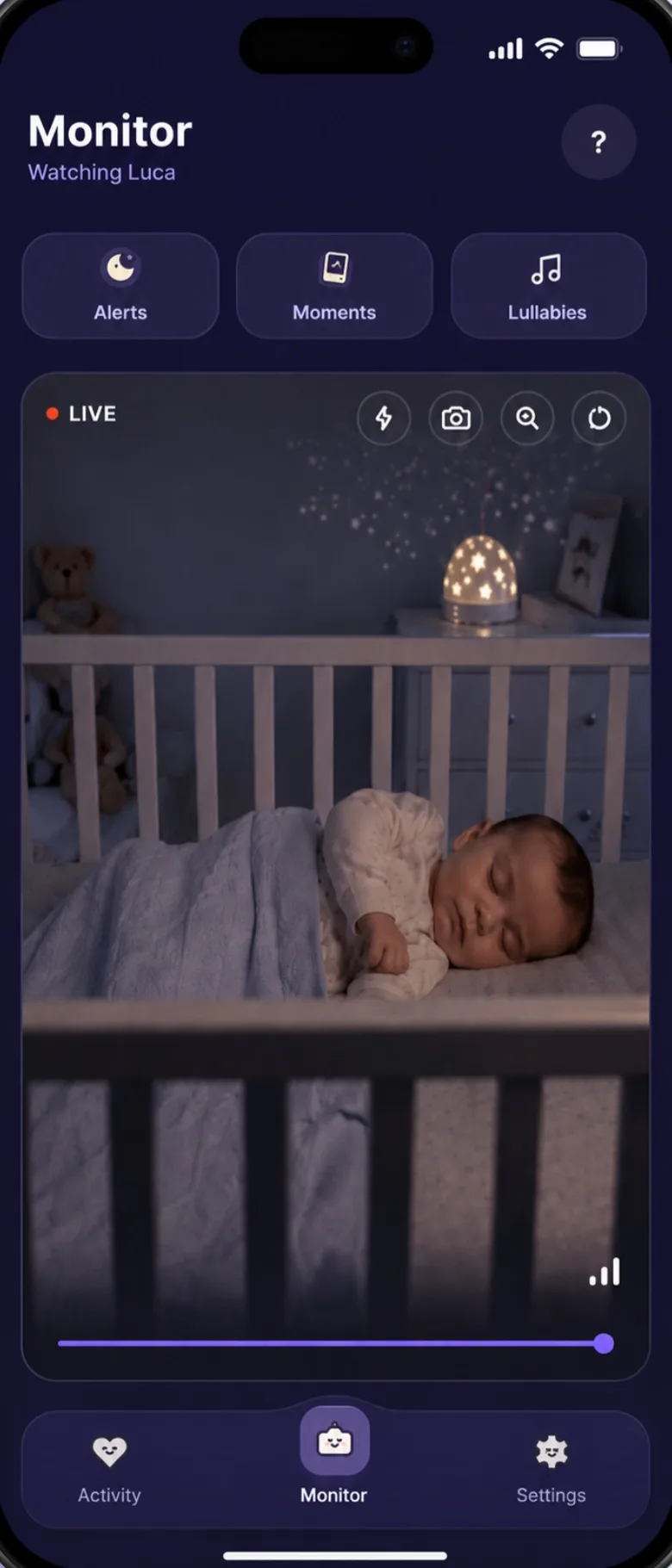
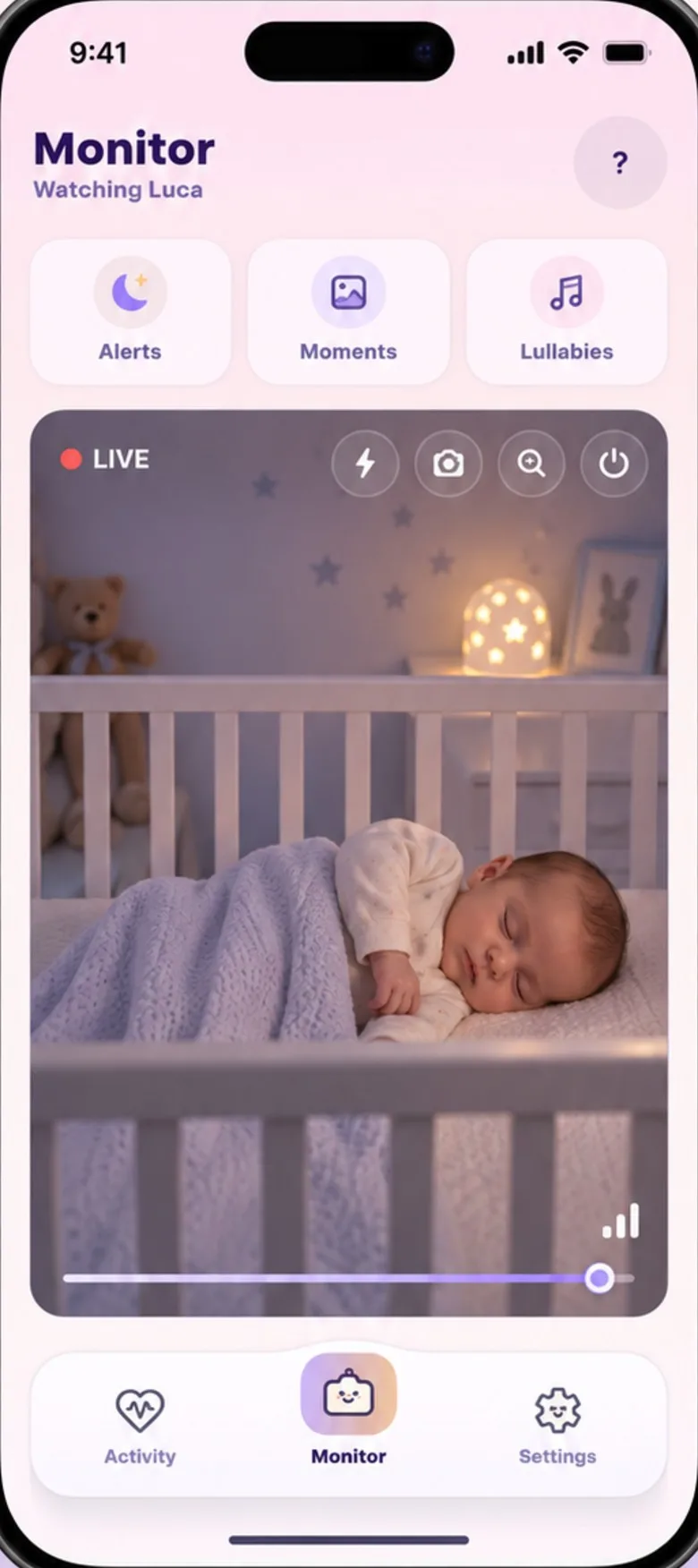
Baby’s Day In keeps an eye on the nursery phone’s temperature. If it runs warm, it asks you before switching to a lighter stream, and it tells you when the battery runs low.
Signs to unplug it
Stop using the phone if the battery shows any of the NFPA’s warning signs: a smell, a change in colour, too much heat, a change in shape, leaking, or odd noises. If it’s safe to, move it away from anything that can catch fire.
A swelling battery often shows as a bulging back or a screen lifting at the edge. The London Fire Brigade says to stop charging straight away, turn the device off, don’t open the casing, and contact the manufacturer or a qualified repairer. A spare phone that has sat in a drawer for a while is worth a look before its first night.
Cords: the risk that’s proven
This one isn’t theoretical. Baby monitor cords strangled seven infants and toddlers between 2002 and 2012, the US Consumer Product Safety Commission (CPSC) reported, aged 6 to 20 months, and three more nearly strangled. The monitors and their cords had been placed within reach.
- Keep cords at least three feet from any part of the crib, bassinet or play yard (CPSC).
- Never put a monitor, or a phone, inside or on the edge of the crib (CPSC).
- Keep the sleep space clear of dangling cords and wires, and keep nothing in the crib but a fitted sheet (AAP).
Three feet is about the width of a crib plus six inches. One metre clears both the CPSC’s rule and the Swiss distance for radio waves.
A safe setup, in six steps
- Place the phone on a shelf or dresser at least one metre, about three feet, from any part of the cot, on a stand, pointed at the cot.
- Run the cable away from the cot, so no part of it is within three feet or within reach.
- Plug in its own charger at the wall, with the adapter at least 50 cm from the cot.
- Leave it uncovered on a hard surface, out of direct sun and away from radiators.
- Turn on battery protection if your phone has it.
- Check it now and then. Warm is normal; hot, swollen or smelly is not.
The settings that keep the phone awake and the stream steady are in the nursery phone checklist, and the reasons behind each placement rule are in where to put a baby monitor.
Phones by the crib, quick answers.
Is it safe to use a phone as a baby monitor?
Yes, with sensible placement. Health agencies have found no evidence that a phone’s radio waves harm health, and exposure drops quickly with distance. Keep the phone and its cable at least a metre, about three feet, from the cot, and charge it on a hard surface with its own charger.
How far should a baby monitor be from the crib?
At least three feet, about a metre, from any part of the crib, and the cord too, says the US Consumer Product Safety Commission. Switzerland’s health office gives one metre for the monitor and 50 cm for its power adapter.
Is it safe to leave a phone charging overnight?
Fire services advise against it where you can avoid it. A nursery phone has to stay charged, so use its own charger, keep it on a hard surface, never covered or on bedding, away from heat, and stop using it if the battery swells, smells or gets hot.
Do baby monitors give off radiation?
Wireless monitors and phones send radio waves. Switzerland’s health office says the levels fall very rapidly with distance, stay below the limits at a metre, and aren’t expected to harm health on current knowledge. It still advises keeping them a metre from the cot.
Is Wi-Fi radiation harmful to babies?
The WHO says no adverse health effect has been causally linked with exposure to wireless technologies. The UK Health Security Agency says exposure from devices kept away from the body is very much lower than from a phone held to the head.
Sources
- US Food and Drug Administration: Cell Phones
- World Health Organization: Radiation, 5G mobile networks and health (Q&A, 2020)
- International Agency for Research on Cancer: IARC classifies radiofrequency electromagnetic fields as possibly carcinogenic to humans (press release 208, 2011)
- Karipidis K, Baaken D, Loney T, et al. The effect of exposure to radiofrequency fields on cancer risk in the general and working population: a systematic review of human observational studies, Part I. Environment International 2024;191:108983
- Swiss Federal Office of Public Health: Baby monitor fact sheet (1 March 2026)
- UK Health Security Agency: Radio waves, reducing exposure from mobile phones
- Federal Communications Commission: Wireless Devices and Health Concerns
- London Fire Brigade: Batteries and chargers
- National Fire Protection Association: Lithium-Ion Battery Safety tip sheet
- US Consumer Product Safety Commission: Safety Alert 5066, baby monitor cords (July 2012)
- American Academy of Pediatrics, HealthyChildren.org: How to Keep Your Sleeping Baby Safe: AAP Policy Explained
- Moon RY, Carlin RF, Hand I, et al. Sleep-Related Infant Deaths: Updated 2022 Recommendations for Reducing Infant Deaths in the Sleep Environment. Pediatrics 2022;150(1):e2022057990