The short answer
In the first days, a formula-fed baby takes about 1 to 2 ounces (30 to 60 ml) a feed every 2 to 3 hours, and a breastfed baby feeds 8 to 12 times or more in 24 hours. By the end of the first month, formula feeds grow to 3 to 4 ounces about every 3 to 4 hours, and by 6 months to 6 to 8 ounces, 4 or 5 times a day. Solids start at around 6 months, with milk the main drink until 12 months. Your baby’s hunger and fullness cues matter more than any chart.
The chart
| Age | Formula, each feed | Formula, how often | Breastfeeding |
|---|---|---|---|
| First week | 1 to 2 oz (30 to 60 ml); as little as ½ oz on day 1 or 2 | Every 2 to 3 hours | Every 1 to 3 hours at first; 8 to 12 times or more in 24 hours |
| End of month 1 | At least 3 to 4 oz (90 to 120 ml) | About every 3 to 4 hours | Every 2 to 4 hours, 8 to 12 times a day |
| Around 6 months | 6 to 8 oz (180 to 240 ml) | 4 or 5 feeds in 24 hours | On demand; solid foods begin |
| 6 to 12 months | Formula or solid foods about 5 to 6 times in 24 hours | On demand, alongside solids | |
Formula amounts are the American Academy of Pediatrics’ (AAP); the timings are the AAP’s and the CDC’s; breastfeeding is the CDC’s, the NHS’s and the World Health Organization’s. A rule of thumb from the AAP: about 2½ ounces of formula a day for every pound your baby weighs (75 ml for every 453 g, roughly 165 ml per kilo), and no more than about 32 ounces (960 ml) in 24 hours.
Sources differ a little on the very first days: the CDC suggests starting at 1 to 2 ounces, while the AAP says babies might take only half an ounce a feed for the first day or two.
If you’re breastfeeding
You can’t measure exactly how much milk a breastfed baby takes, the AAP says, so you go by your baby instead. In the first few days, babies feed every 1 to 3 hours, and at least 8 to 12 times every 24 hours in the first few weeks (NHS). The World Health Organization puts it at 8 to 12 times a day through the first six months.
Over the first weeks and months, most exclusively breastfed babies settle into feeding every 2 to 4 hours, with some clusters of feeds close together and, often, one longer stretch of 4 to 5 hours (CDC). Feed when you see signs of hunger: that’s feeding on demand.
Two reassurances from the NHS: it isn’t possible to overfeed a breastfed baby, and night feeds help, because that’s when your body makes more of the hormone prolactin.
If you’re formula feeding
A newborn’s belly is tiny, so start small (CDC): 1 to 2 ounces every 2 to 3 hours in the first days, 8 to 12 feeds in 24 hours. Amounts grow quickly after that, as in the chart.
Let your baby set the pace. If they get fidgety or easily distracted during a feed, they’re probably finished (AAP).
Night feeds drop away for many formula-fed babies between 2 and 4 months, or once they weigh more than 12 lb (5.4 kg), when most no longer need a feed in the middle of the night (AAP).
Hungry or full? Watch the cues
The CDC’s signs of hunger, from birth to 5 months:
- Hands to the mouth
- Turning their head toward the breast or bottle
- Puckering, smacking or licking their lips
- Clenched hands
Crying is often a late sign of hunger, so try to feed before it starts.
And the signs they’re full: they close their mouth, turn their head away from the breast or bottle, and relax their hands.
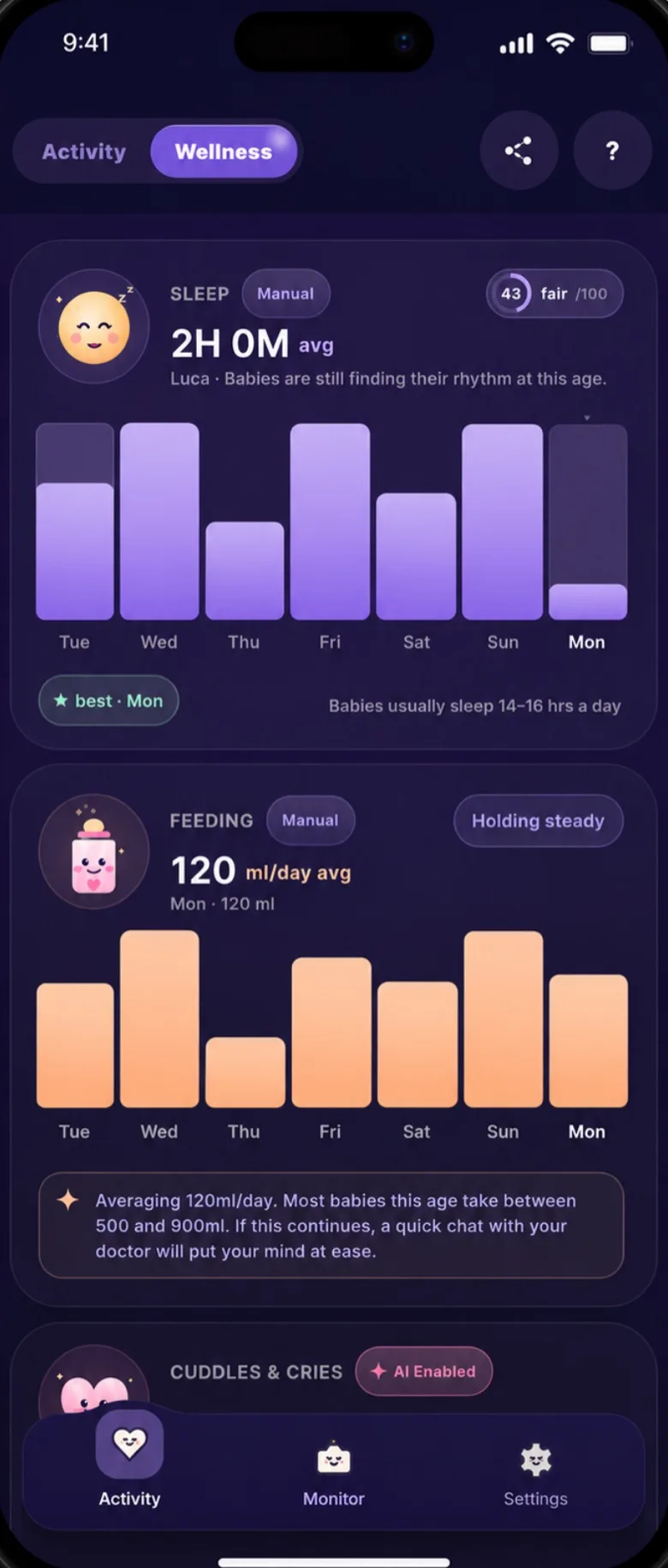
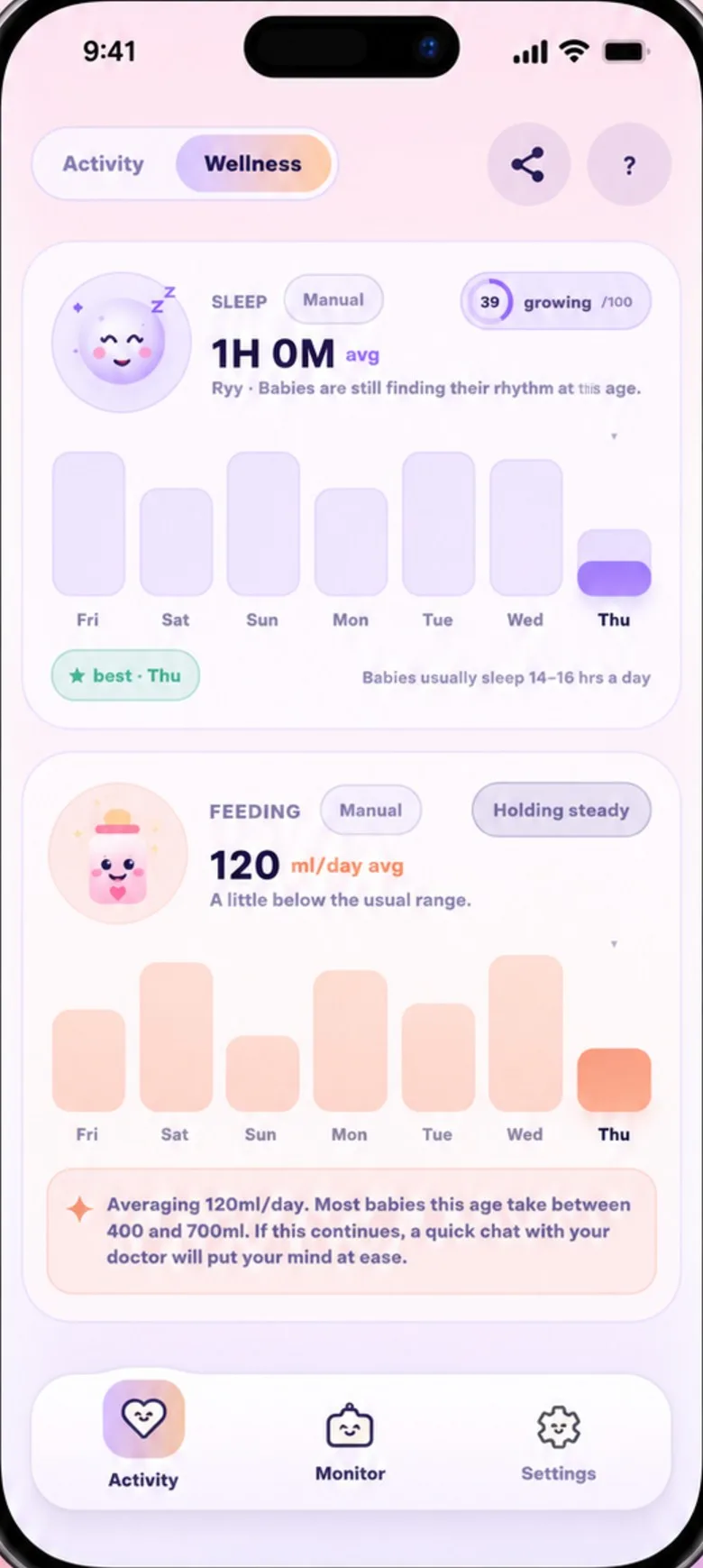
Baby’s Day In logs each feed with the time and the amount, in ml or oz. The week view charts the feed pattern with the average gap between feeds, and the weekly PDF is ready to take to a check-up.
Signs they’re getting enough
- Wet nappies. Only 2 or 3 a day in the first couple of days, then at least 5 to 6 a day after the first 4 to 5 days (AAP). The NHS looks for at least 6 heavy, wet nappies every 24 hours from day 5.
- Weight. Babies lose a little weight after birth, but no more than 8 to 10% in the first few days (AAP). By two weeks they should be back to their birth weight and gaining (AAP).
- Poos. The counts vary by source and by feeding: the AAP looks for at least 4 a day by day four in a breastfed baby, the NHS for at least 2 soft, yellow poos from day four, and at least 1 a day for a formula-fed baby.
Starting solids
At around 6 months (WHO, NHS, AAP), and not before 4 months (CDC). The NHS lists three signs your baby is ready: they can stay sitting up and hold their head steady, coordinate their eyes, hands and mouth to pick up food and put it in, and swallow food rather than push it back out.
Milk stays the main drink: breast milk or formula through the first year (NHS). And a few don’ts from the AAP: no baby cereal in a bottle, because your baby could choke, and no juice before 12 months.
Water: the WHO says not to give water to a baby under six months, even on hot days, and a fully breastfed baby doesn’t need any until they start solids (NHS). For formula-fed babies under 6 months, the NHS says small sips of cooled boiled water may help in hot weather. Ask your doctor or health visitor if you’re unsure.
When to call the doctor
- Fewer than six wet nappies a day after the first week (AAP), or a sunken soft spot on the head (NHS).
- Your baby still seems hungry after most feeds: have them weighed (AAP).
- Still under birth weight at two weeks (AAP).
Get urgent help (NHS) if your baby isn’t feeding, keeps vomiting for 24 hours, has red, black or brown vomit, or hasn’t had a wet nappy for 12 hours.
Feeding, quick answers.
How much should a newborn eat?
About 1 to 2 ounces (30 to 60 ml) a feed of formula in the first week, the AAP says, and sometimes only half an ounce on the first day or two. A breastfed newborn feeds 8 to 12 times or more in 24 hours.
How often should a newborn eat?
8 to 12 times in 24 hours (CDC, NHS). Formula-fed newborns usually eat every 2 to 3 hours; breastfed newborns every 1 to 3 hours at first.
Can you overfeed a baby?
Not a breastfed baby, the NHS says. With formula, watch for fullness cues (closing their mouth, turning away, relaxed hands), and the AAP suggests no more than about 32 ounces (960 ml) in 24 hours.
Do babies need water?
Not before six months, says the WHO, even on hot days, and a fully breastfed baby needs none until solids start (NHS). The NHS does say formula-fed babies under 6 months may need small sips of cooled boiled water in hot weather.
Sources
- American Academy of Pediatrics, HealthyChildren.org: Amount and Schedule of Baby Formula Feedings
- American Academy of Pediatrics, HealthyChildren.org: How Often and How Much Should Your Baby Eat?
- American Academy of Pediatrics, HealthyChildren.org: How to Tell if Your Breastfed Baby is Getting Enough Milk
- American Academy of Pediatrics, HealthyChildren.org: Warning Signs of Breastfeeding Problems
- American Academy of Pediatrics, HealthyChildren.org: When Can Babies Start Solid Foods?
- American Academy of Pediatrics, HealthyChildren.org: Signs of Dehydration in Infants & Children
- CDC: How Much and How Often to Feed Infant Formula
- CDC: How Much and How Often to Breastfeed
- CDC: Signs Your Child Is Hungry or Full
- NHS: Breastfeeding, the first few days
- NHS: Is my baby getting enough milk?
- NHS: Your baby’s first solid foods
- NHS: Drinks and cups for babies and young children
- NHS: When to get urgent medical help for babies and children under 5
- World Health Organization: Breastfeeding, questions and answers