How to take a baby’s temperature.

A hot forehead isn’t a measurement. Which thermometer to use, what counts as a fever by age, and when to call the doctor straight away.

  • By the Baby’s Day In team
  • Published
  • 3 min read

Use a thermometer, not your hand: the AAP says feeling the forehead or skin isn’t accurate. A rectal reading is the most reliable for babies, especially under 3 months. For a baby 3 months or younger, 100.4°F (38°C) or higher is a fever and you should call your pediatrician right away.

Which thermometer to use

The AAP says:

  • Rectal is the most reliable and accurate for infants, especially under 3 months.
  • Oral, ear or forehead (temporal) readings can be used, with 100.4°F (38°C) still as the fever cutoff.
  • Underarm readings may have a lower cutoff for a fever.
  • Ear thermometers should be avoided under 6 months.
  • Fever strips aren’t reliable.

Ask your doctor or nurse to show you the rectal method once, rather than learning it at 3 a.m.

What counts as a fever

The AAP gives these thresholds for when to contact your pediatrician:

  • 3 months or younger: a rectal temperature of 100.4°F (38°C). Call right away.
  • 3 to 6 months: 101°F (38.3°C) or higher.
  • Over 6 months: 103°F (39.4°C) or higher.

These are triggers to call, not a diagnosis. How your baby looks and feeds matters as much as the number.

When to get urgent help

Don’t wait on a number if your baby seems very unwell. The NHS has a full list of when to get urgent medical help for babies and children under 5. The AAP says to call 911 if a febrile seizure doesn’t stop within 15 minutes or your child has trouble breathing.

Before you take it

Read the instructions that came with your thermometer, because each type works a little differently, and don’t take a reading right after a bath or while your baby is bundled up and crying hard. Wait a few minutes after a feed or a cuddle. Write down the reading, the time and the method used. The AAP’s cutoffs differ a little by method, so the doctor will want to know how it was taken.

Teething, heat and fever

The AAP says that if your child is especially miserable or has a fever above 100.3°F (38°C) that you think comes from teething, you should consult your pediatrician rather than assume. It also says that suspected heatstroke needs 911 or the emergency department right away. A very warm room or too many layers can raise a baby’s temperature, so check the room and the layers first, but don’t use that as a reason to delay a call for a baby 3 months or younger.

What to have ready when you call

  • Your baby’s age and last weight, if you know it
  • The temperature, how you took it, and the time
  • How they’re feeding and how many wet nappies they’ve had
  • Other signs: rash, cough, vomiting, unusual sleepiness or fussiness
  • Any medicine you’ve given, with the time

Why age changes the advice

The AAP’s thresholds rise with age: 100.4°F (38°C) at 3 months or younger, 101°F (38.3°C) at 3 to 6 months, and 103°F (39.4°C) over 6 months. A young baby’s fever can be the only sign of a serious infection, which is why the AAP asks you to call right away for the youngest group. At any age, a baby who is hard to wake, struggling to breathe or won’t feed needs help whatever the number says.

Checking without waking

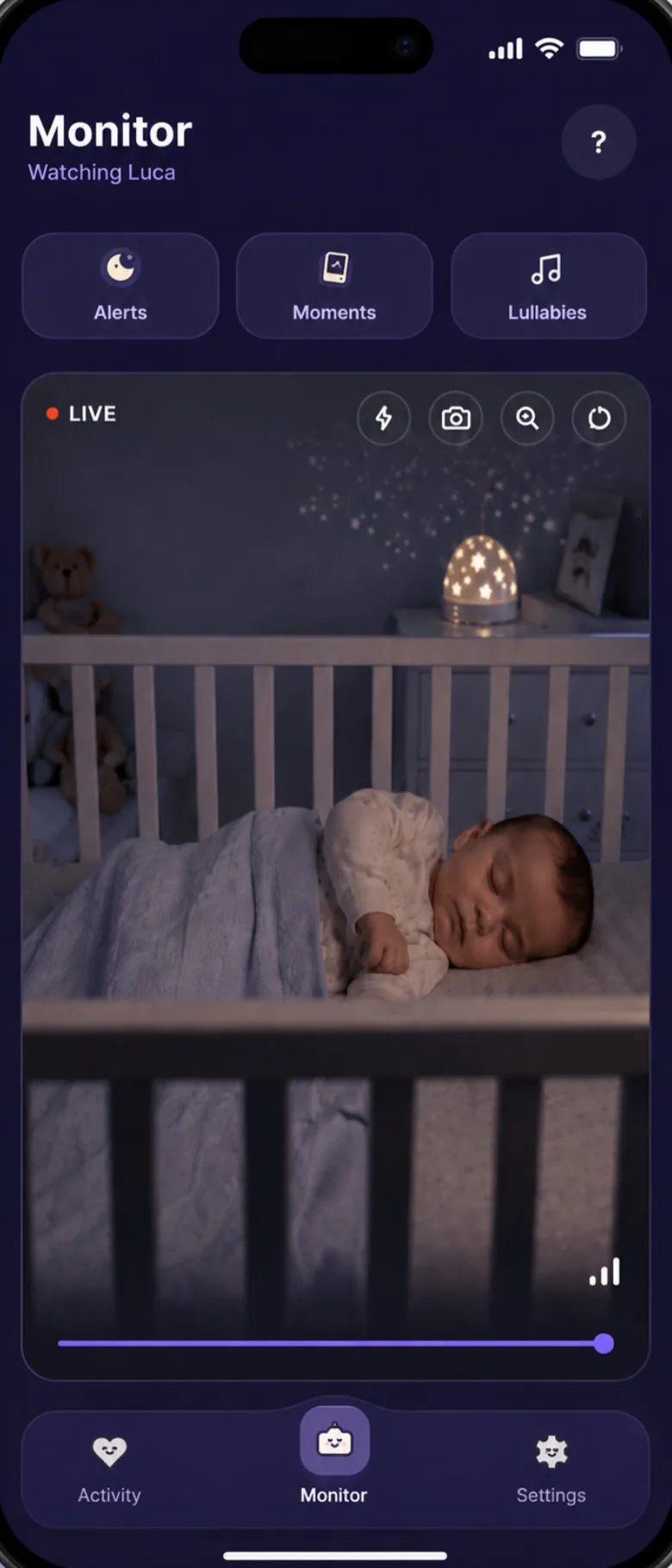
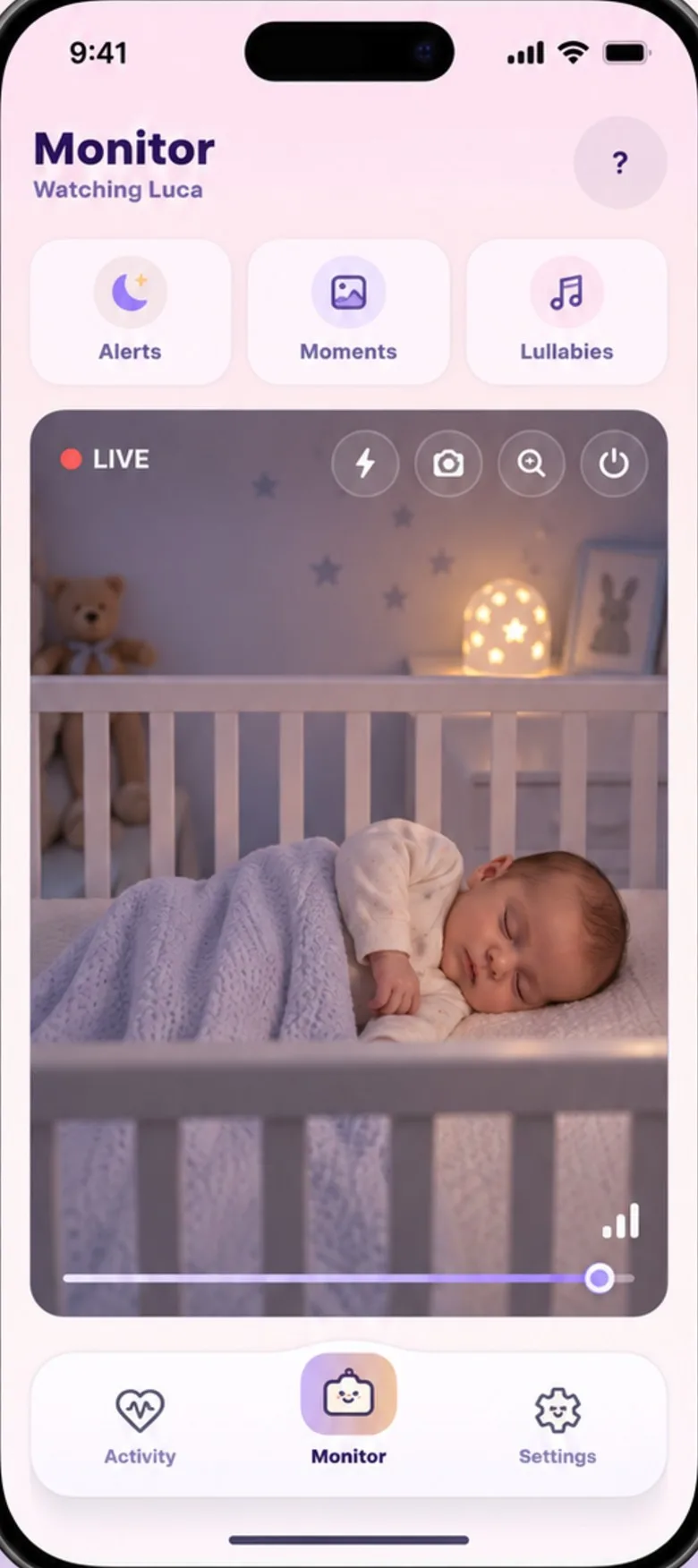
A monitor can’t take a temperature. What it can do is let you see and hear your baby from another room, so you notice restlessness, fast waking or unusual crying earlier, and know when to go in with the thermometer. For the crying side, how to soothe a crying newborn covers when crying is a sign to call.

The nursery phone in a dark room shows what the phone’s camera can see; most phone cameras have no night vision, so a small night light may be needed.

Baby fever, quick answers.

Can I tell if my baby has a fever by touch?

No. The AAP says feeling the forehead or skin isn’t accurate. Use a thermometer.

What temperature is a fever in a newborn?

For a baby 3 months or younger, the AAP says a rectal temperature of 100.4°F (38°C) is a fever, and to call your pediatrician right away.
Sources

  1. American Academy of Pediatrics, HealthyChildren.org: Fever and Your Baby
  2. NHS: When to get urgent medical help for babies and children under 5

Keep reading.

  1. Should you wake a sleeping newborn to feed?

    When to wake a sleepy newborn for a feed, how often newborns need to eat, gentle ways to wake them, and the signs they are getting enough milk.

    • 23 October 2026
    • 4 min read
  2. The right room temperature for baby sleep.

    What room temperature is best for a sleeping baby, how to check if they are too hot or cold, and what to dress them in, with advice from safe-sleep experts.

    • 23 October 2026
    • 3 min read
  3. When to stop swaddling a baby.

    When to stop swaddling a baby, the rolling signs to watch for, how to swaddle without risking hips or overheating, and how to move to a sleep sack.

    • 23 October 2026
    • 3 min read
  4. When can a baby sleep in their own room?

    When can a baby sleep in their own room? What the AAP and NHS advise about room sharing, how to plan the move, and where a baby monitor can help.

    • 23 October 2026
    • 3 min read
  5. Baby spitting up: normal, or not?

    Most babies spit up. What is normal, when it usually stops, tips to reduce it, and the signs, such as green vomit or poor weight gain, that need a doctor.

    • 23 October 2026
    • 3 min read
  6. Baby monitor apps, side by side.

    Baby’s Day In, Cloud Baby Monitor, Baby Monitor 3G, Annie, Nani and Dormi side by side: phones, prices, alerts, lullabies and logs, from each app’s own pages.

    • 7 October 2026
    • 4 min read
  7. Is a phone safe by the crib?

    Radio waves, heat and cords: what the FDA, WHO, fire services and the CPSC say about keeping a phone by the crib, and how to set one up safely.

    • 7 October 2026
    • 5 min read
  8. Do you need a breathing monitor?

    Sock, under-mattress and camera monitors that track breathing or oxygen: what the AAP, FDA and NIH say, what a study found, and what lowers the risk of SIDS.

    • 7 October 2026
    • 5 min read
  9. Baby monitor app, or a baby monitor?

    Should you use a baby monitor app or buy a baby monitor? What each does well, where each falls short, and how to tell which one suits your home.

    • 5 October 2026
    • 4 min read
  10. Where to put a baby monitor.

    How far a baby monitor should be from the crib, how high to put it and where the cable goes, with the CPSC’s three-foot rule. Phones used as monitors too.

    • 5 October 2026
    • 3 min read
  11. Are baby monitor apps safe?

    Where does the video go? Who can watch? What is kept, and for how long? Seven questions to ask any baby monitor app, and how Baby’s Day In answers them.

    • 5 October 2026
    • 4 min read
  12. A travel baby monitor in your pocket.

    Hotels, holiday rentals, a grandparent’s spare room: how to use two phones as a travel baby monitor, what to pack, and what to check in a room you don’t know.

    • 5 October 2026
    • 3 min read
  13. White noise and lullabies: how loud is too loud?

    What a study of infant sleep machines found, what the American Academy of Pediatrics advises, and how to keep white noise and lullabies gentle on small ears.

    • 5 October 2026
    • 3 min read
  14. The newborn sleep schedule.

    Newborns don’t keep a schedule yet. How much they sleep, how often they wake to feed, when longer nights start, and what helps, from the AAP, NHS and CDC.

    • 5 October 2026
    • 3 min read
  15. How to soothe a crying newborn.

    Why newborns cry, how much is normal, the soothing the AAP and NHS recommend, what colic is, and the signs that mean it’s time to call the doctor.

    • 5 October 2026
    • 5 min read
  16. Baby feeding chart, by age.

    How much formula and how often, from the first days to a year, plus breastfeeding, hunger cues and signs of enough. From the AAP, CDC, NHS and WHO.

    • 5 October 2026
    • 5 min read

Notice sooner. Check properly.

Two phones, no extra hardware. Free while we’re in early access.

Baby's Day In Monitor screen: live video of the nursery, with the baby asleep in the cribBaby's Day In Monitor screen: live video of the nursery, with the baby asleep in the crib